Same Answers. Fewer Tokens.
Agentic, detection, and performance benchmarks - what an AI agent spends to finish the job on Owl Browser MCP versus the alternatives, how it scores against CreepJS, and how it keeps pace with bare-metal automation tools under load.
What Does the Same Answer Cost?
The same agent CLIs, the same tasks, the same machine - only the browser MCP server changes. Every stack gets the answer right, so correctness is the entry requirement, not the score. What separates them is what the agent had to spend to get there.
Owl Browser MCP
v1.3.2 · 20 toolsCheap only counts when the answer is right. A stack that quits early looks fast and thrifty on every line above.
Chrome DevTools MCP
v1.6.0 · 29 toolsCheap only counts when the answer is right. A stack that quits early looks fast and thrifty on every line above.
Playwright MCP
v0.0.79 · 24 toolsCheap only counts when the answer is right. A stack that quits early looks fast and thrifty on every line above.
Task by Task
Correct answers first, then what the run cost (all runs). Averaged across every agent CLI until you filter above.
| Task | Owl Browser MCP | Playwright MCP | Chrome DevTools MCP |
|---|---|---|---|
Find the cheapest book in the Mystery category list-extraction | 100%correct 4.5calls 92.3ktokens | 100%correct 6calls 141.4ktokens | 100%correct 4.5calls 119.7ktokens |
Read the last item on the last page of a 1000-item catalogue deep-pagination | 100%correct 1.5calls 35.7ktokens | 100%correct 4calls 94.2ktokens | 100%correct 2calls 49.4ktokens |
Read a value out of an HTML product table table-read | 100%correct 1calls 24.4ktokens | 100%correct 2calls 38.5ktokens | 100%correct 2calls 43.3ktokens |
Open a detail page from a listing and read its stock count detail-drilldown | 100%correct 2calls 43.4ktokens | 100%correct 4calls 67.0ktokens | 100%correct 4calls 99.4ktokens |
Fill and submit a six-field form, report the confirmation code form-fill | 100%correct 4calls 68.7ktokens | 100%correct 9.5calls 117.4ktokens | 100%correct 5.5calls 100.1ktokens |
Negative control: report that a figure is not available negative-control | 100%correct 1calls 24.2ktokens | 100%correct 2calls 38.0ktokens | 100%correct 2calls 42.8ktokens |
Scroll the table sideways to compare every stack
Methodology: Driven by qwen/qwen3.6-27b. 5 runs per task, per stack, per agent. Agent CLIs under test: Claude Code, Codex CLI. Identical prompts and tasks on one machine, only the MCP server swapped. Raw per-run answers are published, so the grading can be audited. Owl is handicapped here and it is not adjusted for: it runs as a server the agent reaches over HTTP, so every call pays network latency, while the other two run in-process on the same machine. That is also the trade - one Owl instance serves many agents concurrently, where a local MCP server is one browser for one agent. Figures cover every run in the set. Dollar cost is not reported - the model runs locally, so any figure the agent CLIs print is fabricated from a hosted pricing table. Owl Browser v1.3.2. Last run: August 7, 2026. The harness, the exact prompts and the grading rules are in the benchmark repository; every raw per-run answer, with its expected value and the rule that graded it, is in the report data this page loads.
Fingerprint controls, tested in public
We ran the same fingerprint collector and performance procedure for each automation stack, then published the versions, screenshots, and raw output. Detection on other sites can differ from these results. This suite includes CreepJS, then pushed under load to show stealth costs nothing in speed.
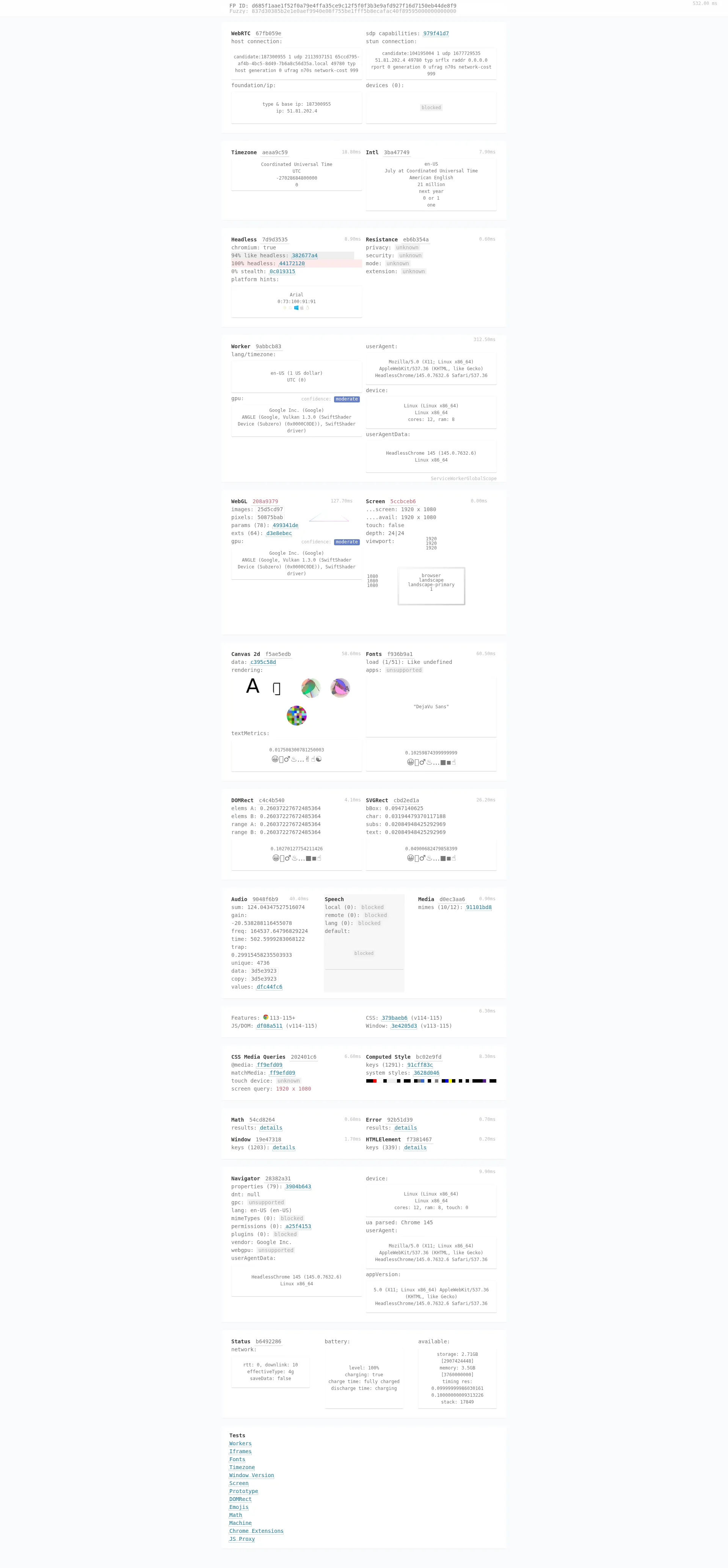
Playwright
baselineRuns on Linux - cannot spoof platform
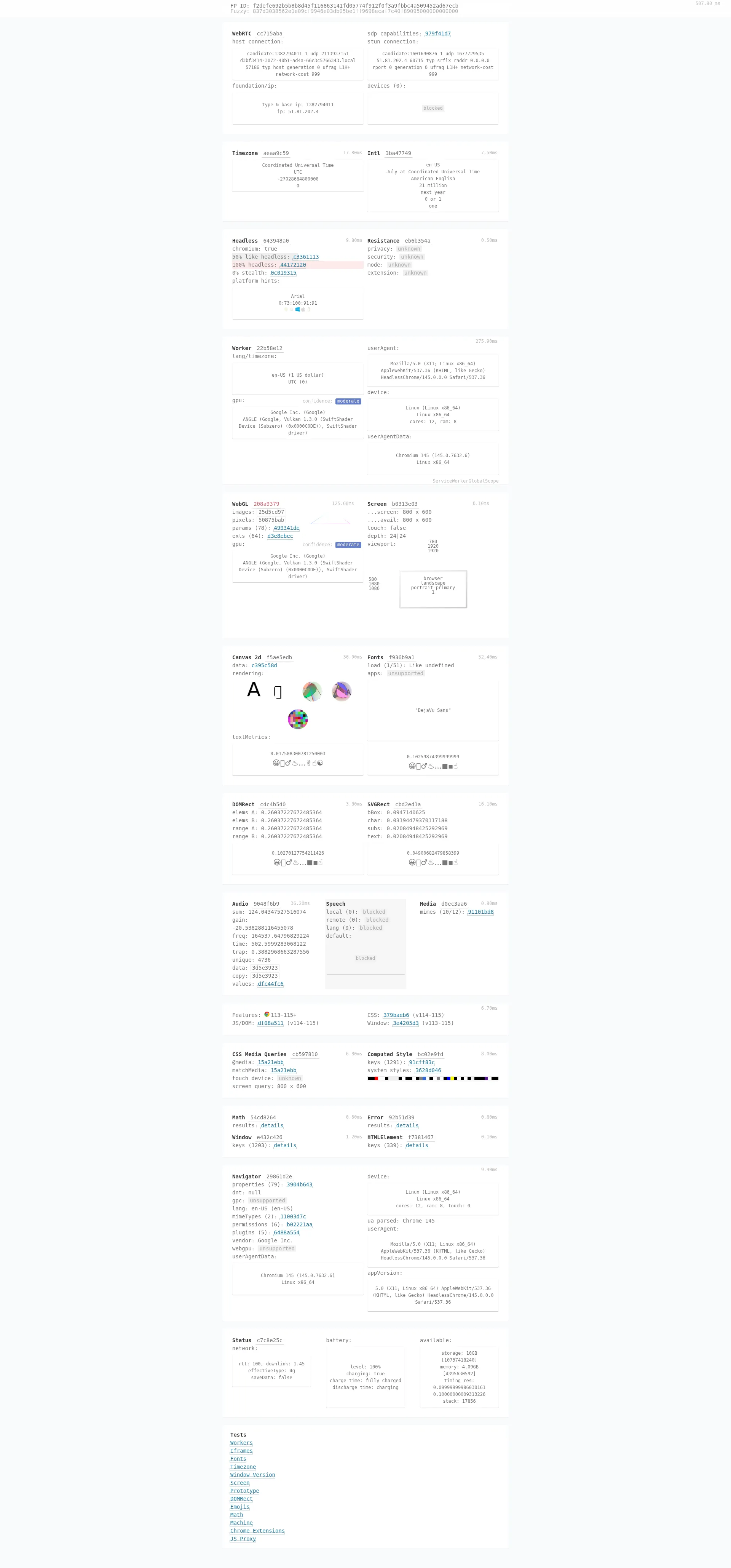
Puppeteer
baselineRuns on Linux - cannot spoof platform
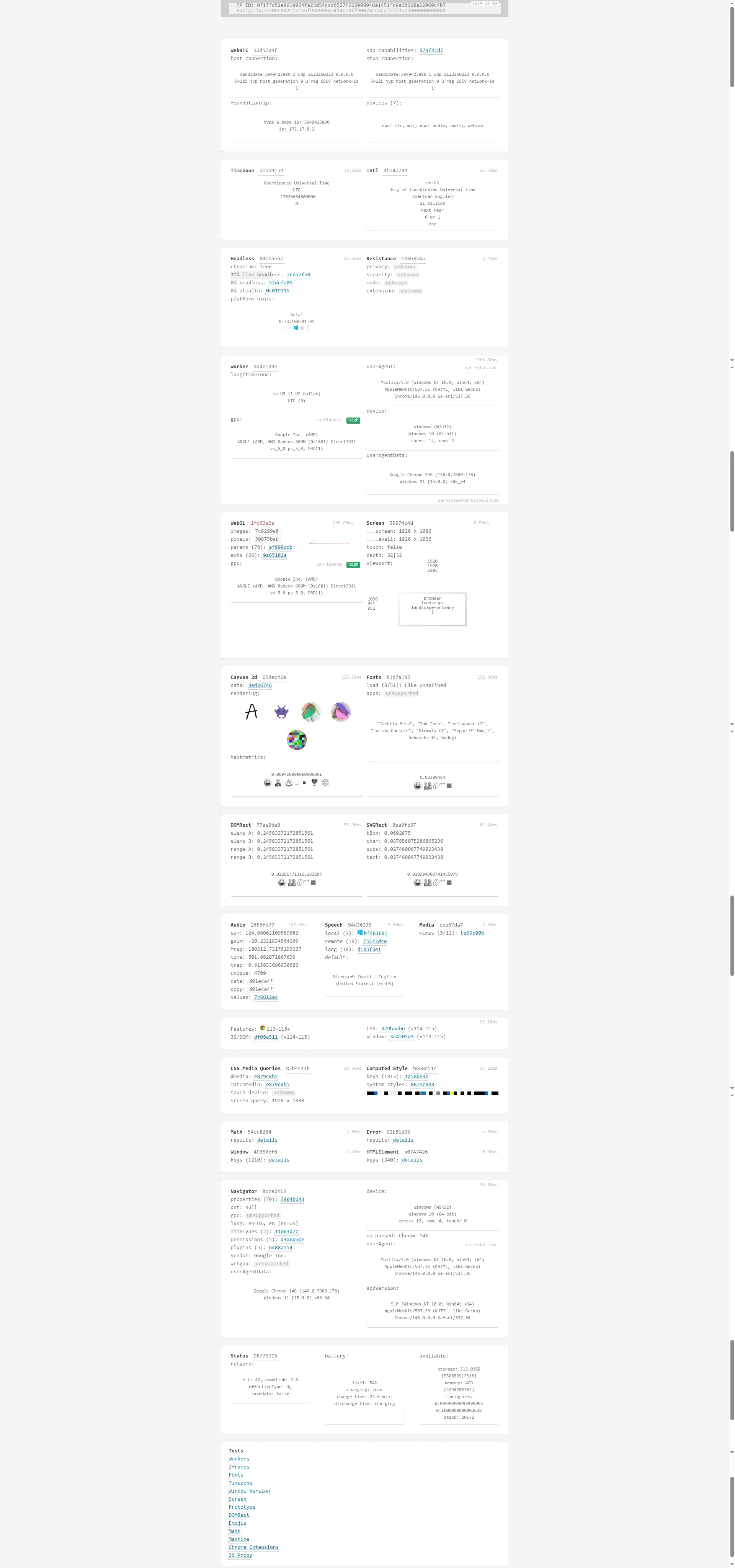
Owl Browser
spoofedUnique fingerprint per context - each session gets its own identity
Fingerprint Uniqueness
Playwright and Puppeteer expose identical device fingerprints - they leak the real machine. Owl Browser generates unique fingerprints per profile at the C++ source level.
| Category | Playwright | Puppeteer | Owl (Windows) | Unique? |
|---|---|---|---|---|
| Canvas | f5ae5edb | f5ae5edb | fdcdbf14 | |
| WebGL | 208a9379 | 208a9379 | b0017f68 | |
| Audio | 9048f6b9 | 9048f6b9 | ae05bdc6 | |
| Fonts | f936b9a1 | f936b9a1 | 023b83e2 | |
| DOMRect | c4c4b540 | c4c4b540 | 8e02378c | |
| SVGRect | cbd2ed1a | cbd2ed1a | cca10e0b | |
| Screen | 5ccbceb6 | b0313e03 | 39974c4d |
Stealth Has a Cost. Here's How Small It Is.
Playwright and Puppeteer run bare - no fingerprint spoofing, no context isolation, no anti-detection. Every Owl request includes all of that, yet full-cycle times stay competitive. 1000 sequential iterations per browser, same machine, same network. Median times shown.
Cold Start
median (p95)Creating a browser context (Owl) vs launching a browser process (Playwright/Puppeteer)
Navigation
median (p95)Navigate to https://example.com and wait for network idle
Screenshot
median (p95)Capture a viewport screenshot
Close
median (p95)Close browser context (Owl) or terminate browser process (Playwright/Puppeteer)
Full Cycle
median (p95)Create → navigate → screenshot → close
Methodology: Each browser performs 1000 sequential iterations of: create/launch → navigate to target URL (wait for domcontentloaded) → capture screenshot → close. All times in milliseconds. Playwright and Puppeteer run inside the benchmark container (local process). Owl Browser runs in a separate container and is accessed via REST API over localhost, adding ~5-10ms of network overhead per API call - Owl's real times are faster than shown. Sequential execution, same machine. Owl times include the full cost of stealth - fingerprint generation, per-context isolation, and REST API overhead to an isolated container.
Concurrency Scaling
All sessions launch simultaneously. Each performs a full cycle - create context, navigate, screenshot, and close.
Methodology: At each concurrency level (1, 10, 25, 50, 100 sessions), all sessions launch simultaneously and each performs: create → navigate (domcontentloaded) → screenshot → close. Playwright and Puppeteer each launch a separate browser process per session. Owl Browser creates lightweight contexts within a single running engine. Total time = wall clock from first launch to last completion.
Run the same tests in your environment
Our published run shows the measured fingerprint and performance results above. It does not guarantee that every detector, site, account, or proxy will accept a session. Clone the harness, reproduce the run, and test the sites that matter to your workflow.
Get StartedTested by the Olib engineering team·Owl Browser v1.3.0·Playwright (chromium)·Puppeteer (Chrome/145.0.7632.6)·Last run: July 7, 2026
Detection powered by CreepJS · View report generator source code
Methodology maintained by Akram H. S., Founder and CTO · Architecture and limitations